
Student Driver Magnet vs. Sticker: Which Should You Buy?
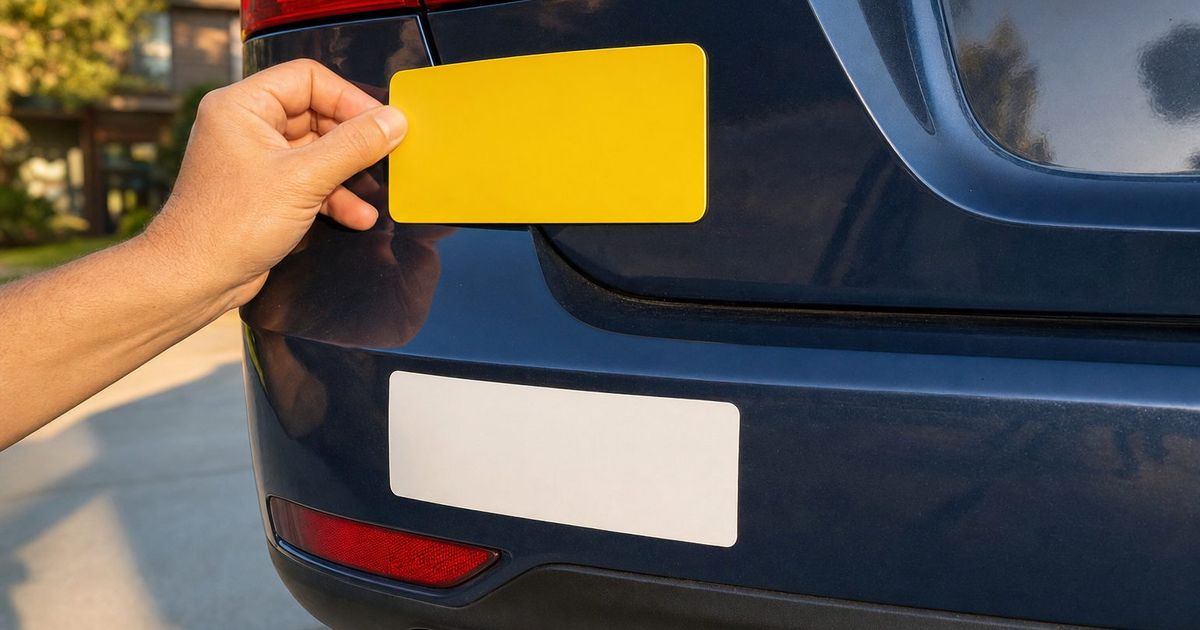
A student driver magnet is the fastest, cheapest way to tell other drivers a learner is behind the wheel. It goes on in seconds and comes off when a parent drives. A student driver sticker stays on the car full time and holds up better at highway speed. If you share one car between a learner and an experienced driver, buy a magnet. If the car belongs to the new driver, a sticker is the better tool, and a QR sticker is the only option that tells you how the drive actually went.
Here is how the two compare, and how to pick the right one.
What a Student Driver Magnet Does Well
The magnet is popular for good reason. It solves the shared-car problem.
- It comes off in seconds. Mom drives to work in the morning, the teen practices after school. Pull the magnet when the learner is not driving.
- It costs almost nothing. Most sell for a few dollars at auto parts stores, big-box retailers, and online.
- It leaves no residue. Nothing to scrape off when the permit phase ends.
- It is easy to read. The classic yellow or white sign with bold black letters reads clearly from a car length back.
For a family with one car and a short permit window, a magnet is a reasonable choice.
Where Student Driver Magnets Fall Short
Magnets have real limits that most listings skip.
They do not stick to every car
Car magnets only hold on steel panels. Manufacturer care guides warn that magnets will not adhere to aluminum body panels, aftermarket fiberglass parts, or areas repaired with body filler. Some vehicles use aluminum on body panels. Test the spot with a refrigerator magnet before you buy.
They can blow off at speed
Wind pushes hard against a flat sign. If there is any gap between the magnet and the paint (a factory decal, a body line, a curve), air gets under the edge and lifts it. Once your teen starts practicing on the highway, a loose magnet can end up on the road behind you.
They need care to protect the paint
Magnet makers recommend removing the magnet weekly to let the surface and the magnet back dry out, and pulling it before any automatic car wash. Moisture and grit trapped underneath can mark the paint over time. In cold weather, most magnets need to be around 50°F to conform to the panel properly.
They fall off the routine
A magnet that comes off for the parent's commute also has to go back on for every practice drive. Busy families forget. A warning that is sitting in the trunk does not warn anyone.
What a Student Driver Sticker Does Better
A sticker, or student driver bumper sticker, trades removability for reliability.
- It is always on. No remembering, no swapping, no lost magnet.
- It stays put at highway speed. Adhesive does not lift in wind the way a magnet can.
- It works on any body panel. Aluminum, plastic bumper covers, and glass are all fine.
- It fits the car the teen drives most. If the learner has a dedicated car, the sticker belongs there for the full permit phase and the first year of licensed driving.
The trade-off is plain. If a parent also drives that car every day, the sticker stays visible during the parent's drives too. Some families are fine with that. Others prefer the magnet for that reason.
The Question Neither One Answers
A magnet and a standard sticker both do the same single job: they ask other drivers for patience. That matters, because less pressure from the car behind helps a nervous learner.
But neither one tells you anything. You still do not know what happened between your driveway and the school parking lot. Did your teen roll the stop sign on the corner? Change lanes without checking the mirror? Or handle a tricky merge perfectly?
That gap matters most in the first months. According to the CDC, crash risk is particularly high during the first months of licensure, and the crash rate per mile driven for 16-year-olds is about 1.5 times the rate for 18 to 19 year olds. The riskiest stretch of driving is also the one parents see the least of.
The Third Option: A QR Student Driver Sticker
A QR student driver sticker from Judge My Driving keeps the warning function and adds a feedback loop.
- Other drivers see a clear student driver message. Same patience signal as a magnet.
- Anyone can scan the QR code and rate the drive. It takes under 30 seconds, with no app and no signup.
- Ratings land in a private parent dashboard. Each one is time-stamped, so you can talk about it while the drive is still fresh.
- Good driving gets recorded too. Star ratings capture the smooth merge, not only the mistakes, so you have something to praise as well as something to fix.
Feedback is anonymous in both directions. Scanners do not share who they are, and the code never exposes your driver's name, address, or phone number.
When your teen gets a license, keep the same account and swap to a new driver sticker. The feedback history carries forward.
Magnet vs. Sticker vs. QR Sticker: Quick Comparison
Student driver magnet
- Cost: a few dollars, one time
- Best for: one shared car, short permit window
- Holds at highway speed: only with flat, full contact
- Works on aluminum or fiberglass panels: no
- Tells parents what happened: no
Standard student driver sticker
- Cost: a few dollars, one time
- Best for: a car the learner drives most
- Holds at highway speed: yes
- Works on any panel: yes
- Tells parents what happened: no
Judge My Driving QR student driver sticker
- Cost: $99 per year for the Family plan (up to 3 vehicles, stickers included) or $49 per year for a single driver
- Best for: parents who want to know how the drive went
- Holds at highway speed: yes
- Works on any panel: yes
- Tells parents what happened: yes, with real-time ratings
How to Choose in 30 Seconds
- One car, parent drives it daily, permit phase only: a magnet is fine. Test the panel first and pull it before car washes.
- The teen has a dedicated car: use a sticker. It stays on and holds at speed.
- You want to know how your teen actually drives when you are not in the passenger seat: use a QR student driver sticker.
Some families use both: a magnet for the shared car and a QR sticker on the car the teen drives most.
Where to Put It
Placement is the same for all three options.
- Put it on the lower rear of the car, visible to a driver one car length back.
- The rear bumper or the lower corner of the rear windshield both work.
- Keep it out of the driver's line of sight and off the license plate.
- For a magnet, pick a flat steel panel with no decals or body lines under it.
Frequently Asked Questions
Are student driver magnets safe for car paint?
Generally yes, with care. Remove the magnet weekly, clean and dry both surfaces, and take it off before automatic car washes. Trapped moisture and grit are what cause marks.
Why does my student driver magnet keep falling off?
The most common causes are a non-steel panel (aluminum or fiberglass), a curved surface, or a decal or body line that leaves a gap. Air gets under the edge at speed. Move it to a flat steel panel or switch to a sticker.
Do student driver signs actually help?
They help as a signal. The sign asks surrounding drivers for more room and more patience. A QR version adds the part a plain sign cannot: a record of how the drive went.
Can I use a student driver sticker after my teen gets a license?
A student driver message no longer fits once your teen is licensed. Switch to a new driver sticker for the first year of solo driving, when crash risk is still highest.
Which One Should You Buy?
A magnet buys patience for a few dollars. A sticker buys the same patience and stays on the car. A Judge My Driving student driver sticker buys patience plus the one thing parents want most in the permit phase: an honest account of the drive from the people who were actually there.
Ready to make the roads safer?
Get your Judge My Driving sticker and join thousands of drivers committed to accountability.