
How to Teach a Teen to Drive: A Lesson-by-Lesson Plan
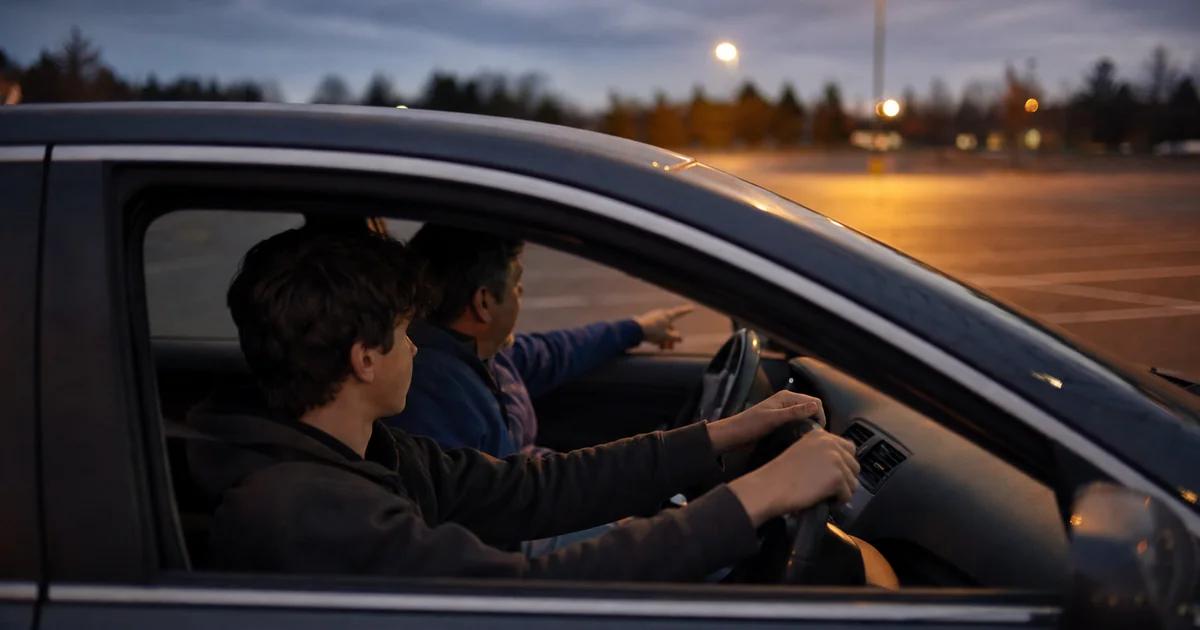
Teach a teen to drive in stages: parked car, empty lot, quiet streets, busier roads, night, rain, then highway, and move on only when the current stage is boring. The Insurance Institute for Highway Safety (IIHS) reports that the quality and variety of supervised practice matters more than the raw hour count, so this plan is built around situations, not a stopwatch.
You are also the only safety system in the car for the first several months. Per IIHS, teen drivers crash at over 4 times the rate of drivers 20 and older per mile driven, and crash risk is particularly high during the first months of licensure. The lessons below are about building habits that hold once you are no longer in the passenger seat.
Why does supervised practice matter so much?
Because inexperience is the problem, and supervised miles are the only cure. IIHS says immaturity leads to speeding and other risky habits, while inexperience means teens often do not recognize hazards or know how to respond. Excessive speed is a factor in almost a third of teen drivers' fatal crash involvements, and many fatal teen crashes involve only the teen's vehicle.
Two more findings from the same IIHS summary shape this plan:
- Parents can enforce the same rules as a model graduated licensing law even where state law is weak: require and supervise practice, then restrict passengers and night driving after licensure.
- Teens benefit from exposure to diverse driving situations while still supervised.
How many supervised hours does your state require?
It depends on the state, and the number is a floor, not a target. IIHS lists at least 70 supervised practice hours as current best practice, well above what most states mandate. Here is what four large states require, each from the state licensing agency's own page.
State | Supervised hours required | Night hours included | Permit holding period | Source
Texas | 30 hours behind the wheel | At least 10 at night | At least six months (expires at 18) | Texas DPS
Florida | 50 hours | 10 at night | Minimum 12 months or until 18th birthday | FLHSMV
Georgia | 40 hours | 6 at night | 1 year and 1 day | Georgia DDS
Ohio | 50 hours, logged on the Fifty-Hour Affidavit | At least 10 at night | At least six months | Ohio BMV
For every other state, the IIHS graduated licensing laws table has the current learner-stage requirement. Confirm it against your own DMV, since IIHS notes the table is for general information and may lag changes. Texas parents can find the full permit timeline in our Texas learners permit guide.
Log every session from day one: date, minutes, route type, weather, one note.
What should the first lessons cover?
The car itself, parked, before anything moves. Then an empty lot. This part is slow and it should be.
Lesson 1, parked. Seat, mirrors, steering wheel reach, pedals, parking brake, lights, wipers, hazards, defrost, horn. Have your teen find every control without looking.
Lesson 2, empty lot, rolling. Smooth starts and stops. Creep, brake, creep, brake, until the stops no longer throw your head forward. Then straight-line driving at walking pace, then slow turns with hand-over-hand steering. Keep it short. The American Safety Institute suggests ten to twenty minutes of focused practice beats an hour that ends in frustration.
Lesson 3, empty lot, control. Backing in a straight line, backing around a corner, pulling into and out of a marked space, three-point turns, holding a steady speed. Repeat until it is dull.
Rules for you: speak early, speak calm, one instruction at a time. "Brake now" is useful. "Why didn't you see that" is not.
When is your teen ready for real roads?
When the lot is boring and the car no longer surprises them. Move to quiet residential streets in daylight and dry weather.
Lesson 4, neighborhood streets. Lane position, stop signs, right turns, then left turns, then four-way stops. Talk through right of way out loud before each intersection. Your teen should be looking a block ahead, not at the hood.
Lesson 5, following distance and mirrors. On a slightly busier two-lane road, teach a counted following gap and regular mirror checks. Have your teen narrate what they see: brake lights ahead, a cyclist on the right, a car waiting to pull out. Narration tells you what they are noticing, which is the skill IIHS says new drivers lack most.
Lesson 6, arterials and signals. Multi-lane roads at the posted speed. Lane changes with signal, mirror, head check. Protected and unprotected left turns. Yellow-light decisions.
Add one new element per session. If a session goes badly, drop back a lesson next time rather than pushing through.
How do you teach night, rain, and highway driving?
On familiar routes first, one condition at a time, because each one changes what the eyes have to do.
Lesson 7, night. The Lesson 4 streets, after dark, dry. Headlights, when to dim high beams, judging distance to oncoming cars, slowing down because you cannot see as far. IIHS reports that 35 percent of teen driving fatalities in 2024 occurred between 9 p.m. and 3 a.m., and 53 percent between 6 p.m. and 3 a.m. That is why the state requirements above include night hours.
Lesson 8, rain and wet roads. Same familiar routes, lower speeds, longer following distance, gentle braking. If you live where it snows, do a snow session in an empty lot before any snow on a public road. Skip anything that looks like stunt training. IIHS found that skid control and other advanced skill courses seem to increase crash risk, likely because they make young drivers overconfident.
Lesson 9, highway. Only after Lessons 4 through 8 are solid. Pick a light-traffic time, a long on-ramp, and a short stretch with an easy exit. Teach merging at the speed of traffic, holding the right lane, keeping the gap, and exiting. Next session, add one lane change. Then moderate traffic. Then night.
Lesson 10, the drives they will make alone. School, work, practice, a friend's house, the grocery store. Run each one supervised, both directions, daylight and dark. These routes get the unsupervised miles, so they deserve the most reps.
What rules should apply once they are licensed?
The same ones a strong graduated licensing law would impose: no teen passengers and no late-night driving for the first months, seat belts every ride, zero phone use. IIHS summarizes studies showing that passengers increase crash risk for teenage drivers, and that strong nighttime and passenger restrictions reduce fatal crashes. Your state's rules are the minimum; who can ride with a permit driver covers the learner-stage limits by state.
Write the rules down. A short signed agreement works better than a lecture, and our parent-teen driving agreement post has a template.
What happens after you get out of the car?
You lose your only source of information, right when the risk peaks.
The research is specific about what helps. IIHS reports that in a study of an in-vehicle monitoring system, teen seat belt use improved when violations were reported to parents, and a separate randomized study found that feedback to teens on risky driving reduced it only when parents received the feedback too. Feedback to the teen alone did not. The teen has to know that someone who matters will see it.
Parents have a few ways to keep that loop open, each with tradeoffs:
- Phone apps and built-in car modes see speed, hard braking, and location. They see nothing about how the drive looked to the people around the car, and many teens resent being tracked.
- Riding along occasionally is free and tells you a lot, but your teen drives differently when you are there.
- A QR-coded student driver sticker turns the other drivers on the road into the feedback source. The Judge My Driving student driver sticker keeps the usual "please be patient" signal and adds a code anyone behind the car can scan to rate the drive in under 30 seconds, no app. Ratings land in your dashboard with a time stamp, so you can ask about the merge while it is still fresh. Good driving gets recorded too.
Be clear-eyed about what a sticker does not do. It does not know where the car is, it does not see inside the cabin, and a stranger's rating can be unfair or plain wrong. Treat it as a pattern detector over weeks, not a verdict on a single drive. The Family plan is $99 a year for up to three vehicles with stickers included; the Individual plan is $49 a year. After the road test, swap to a new driver sticker on the same account.
Frequently asked questions
How long does it take to teach a teen to drive?
Plan on the full permit holding period your state sets, which is six months in Texas and Ohio, 12 months in Florida, and a year and a day in Georgia per each state's licensing agency, and use all of it. IIHS lists at least 70 supervised hours as best practice and cites research finding the permit holding period itself matters.
What order should I teach driving skills in?
Parked controls, empty lot, quiet streets, busier roads, night, rain, highway, then the specific routes your teen will drive alone. Move on only when the current stage is routine. The IIHS driving skills checklist gives you a skill-by-skill list to grade against.
Should I pay for driving school instead of teaching my teen myself?
Many states require some formal driver education, so it is usually both. Texas, Georgia, and Ohio all require driver education hours on top of the supervised practice hours above, per their state pages. IIHS notes that evaluations of U.S. high school driver education programs show little or no reduction in crashes per licensed driver, so the hours with you still carry most of the weight.
How do I stay calm while teaching my teen to drive?
Keep sessions short, teach one thing per session, give instructions early, and pull over before you say anything you would not say to a coworker. The American Safety Institute lists raising your voice and teaching too much at once as the most common parent coaching mistakes. Your teen also copies how you drive.
Is teen crash risk getting better?
Yes, over the long run. IIHS reports that between 1996, when the first three-stage graduated licensing program began in the United States, and 2024, teenage crash deaths declined by 50 percent, from 5,819 to 2,899.
Keep the feedback loop open after the permit
You can teach every lesson above and still have no idea what the first solo month looks like. The student driver sticker gives you a window into it, built from what the road saw. See the teens page for how families use it.
Sources
- IIHS, Teenagers
- IIHS, Graduated licensing laws table
- IIHS, Driving skills checklist
- Texas DPS, Texas Learners License as a Teen
- Texas DPS, Texas Provisional License as a Teen
- FLHSMV, Teen Drivers
- Georgia DDS, Teen Drivers
- Ohio BMV, Graduated Driver Licensing
- American Safety Institute, The Ultimate Guide to Teaching Your Teen to Drive
- Judge My Driving, Student Driver Sticker
- Judge My Driving, Pricing
Ready to make the roads safer?
Get your Judge My Driving sticker and join thousands of drivers committed to accountability.